

Last Updated: November 1, 2026
Quick Summary
To organize tech accessories for travel, start with a compact zip-around travel cable organizer that has elastic loops for cables and mesh pockets for a power bank and earbuds. Pack only the essentials you use daily, coil each cable and secure it with a velcro tie, and label both ends by device.
- Bundle each cable with a velcro tie or silicone strap and label both ends before your trip.
- Layer soft items at the bottom, devices in the middle, and cables in a dedicated pouch on top.
- Coil cables loosely around three fingers instead of folding them to protect the internal wires.
- Pack for the trip you're taking: an overnight kit skips the laptop and tablet entirely.
- Keep a small cable repair kit with a spare velcro tie, washi tape, and a spare cable.
Table of Contents
- Start With a Travel Cable Organizer That Works for You
- Travel Tech Essentials You Will Actually Use
- How to Pack Electronics for Travel Without the Bulk
- How to Keep Cables From Tangling in Your Bag
- Protect Your Devices and Tech Accessories in Transit
- Build a Packing System for Different Trip Types
- Pack Your Tech Accessories With Confidence
- Frequently Asked Questions
Start With a Travel Cable Organizer That Works for You
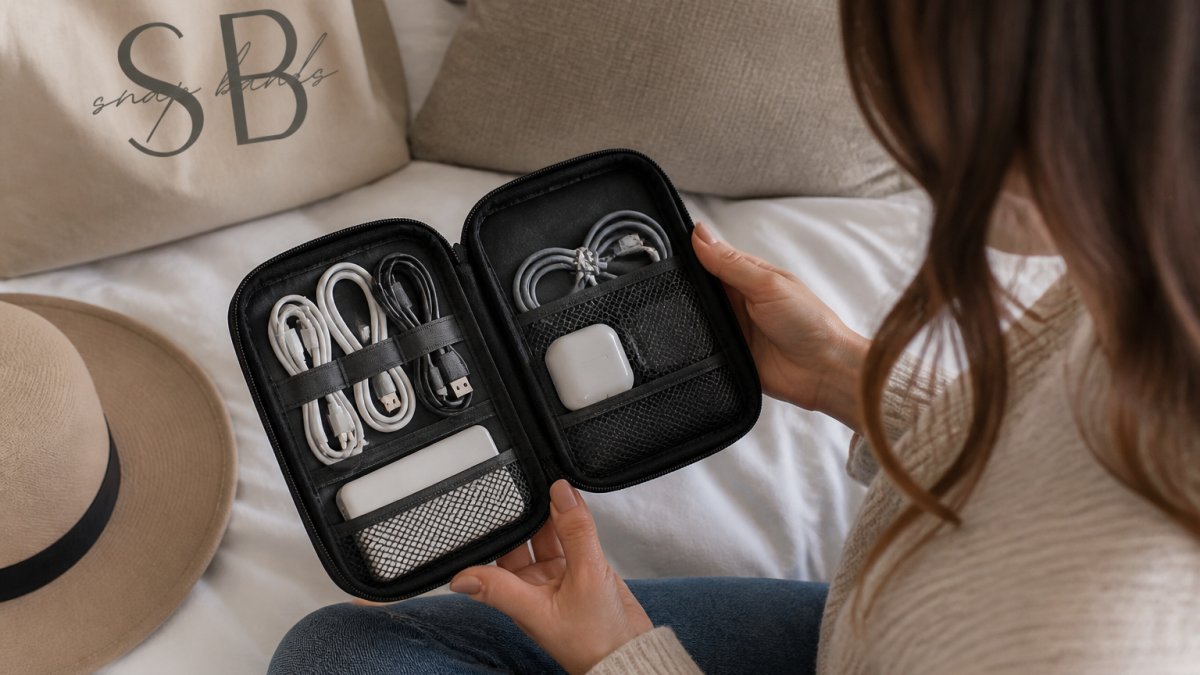
Learning how to organize tech accessories for travel starts with one purchase: a travel cable organizer. A compact zip-around pouch can hold your chargers, cables, and earbuds in separate compartments so nothing tangles or disappears.
A helpful organizer tends to have a few useful features:
- Elastic loops for cables, so each one has a home
- Mesh pockets for a power bank and earbuds
- A zip closure that holds up in a carry-on
- A slim, flat shape that slides into a tote or backpack sleeve
Large multi-layer cases can eat space you need for clothes, so a compact organizer helps you pack only what you'll actually use.
If you're still deciding on your everyday carry setup, our guide on how to choose a phone case with card holder and strap pairs well with any travel kit.
Travel Tech Essentials You Will Actually Use
Most packing lists overstuff. The travel tech essentials that earn their place are the ones you reach for daily at home. If you're shopping for someone else, our best gift ideas for tech lovers can help you choose gear they'll actually use. A common mistake is packing three chargers "just in case" and using one.
Here's what we'd pack:
- One phone charger and one cable
- A power bank for long travel days
- A travel adapter if you're crossing borders
- Earbuds or headphones
- A tablet or e-reader for the flight
- A compact power strip if you share hotel outlets
Everything else is weight. Your laptop only comes if you'll genuinely work.
How to Pack Electronics for Travel Without the Bulk
Packing electronics for travel without bulk comes down to layering. Put soft items at the bottom, devices in the middle, and cables in a dedicated pouch on top. This protects screens and keeps your bag flat enough to close.
Follow this order:
- Lay your organizer flat at the bottom of the tech sleeve
- Stack devices screen-to-screen with a soft cloth between them
- Add the power bank in its own pocket, never loose against a screen
- Zip the sleeve and slide it into your carry-on's laptop compartment
Watch out: never pack a loose power bank next to your phone. Metal contacts and keys can scratch a screen fast.
How to Keep Cables From Tangling in Your Bag
Keeping cables from tangling takes about ten minutes of setup before your trip. The fix is simple: bundle each cable with a velcro tie or silicone strap, then label both ends. You'll never dig through a nest of cords again.
Our labeling system:
- Color-code by device: one color per phone, tablet, watch
- Write the device name on a small sticker near each plug
- Coil, don't fold cables to protect the internal wires
- Store each cable in its own loop inside the organizer
A cable that's coiled lasts far longer than one folded in half. That small habit saves replacements.
A Practical Cable and Charger Labeling System
Most travel advice stops at "use velcro ties." That's not a system, it's a single step. Here's a repeatable labeling method that works whether you're packing for a weekend or a two-week work trip.
Step 1: Assign a color to each device. Use small dot stickers or colored washi tape, both are cheap, removable, and easy to find at any craft or office supply store. For example: pink for your phone, mint for your tablet, lavender for your watch, and gold for your power bank. Wrap a small piece of tape around both ends of each cable so you can identify it at a glance, even in dim airplane lighting.
Step 2: Label the charger, not just the cable. Chargers look identical until you're squinting at tiny print in a hotel room. Write the device name ("phone," "tablet") on a small sticker and place it on the charger brick itself. If you use a multi-port charger, label which port is for which device with a tiny sticker next to each port.
Step 3: Match cables to chargers with a simple rule. Keep one cable permanently paired with each charger using a small silicone tie or a hair elastic. This prevents the "which cable goes with which brick" shuffle and means you never pack a charger without its cable.
Step 4: Use a coil-and-tie method that protects the wire. Coil cables loosely around three fingers, never fold them in half, and secure with a velcro tie or silicone strap. Folding creates stress points at the bend, which is where most cable failures start. A coiled cable lasts far longer than one folded flat.
Step 5: Store each cable in its own loop inside the organizer. Elastic loops in a travel organizer are designed for exactly this. If your organizer doesn't have enough loops, use small mesh pouches or even a clean sunglasses case to keep each cable separate.
Protect Your Devices and Tech Accessories in Transit
Protection is where most packing advice falls short. Your phone and watch take the most abuse in transit, so give them a case before they ever hit the bag. A durable case absorbs the knocks that happen in overhead bins and taxi doors.
For your watch, a protective cover keeps the screen and edges safe without adding bulk. Our 2-pack Riggi watch case covers both screen and edges, and the two-pack means you always have a backup. For your phone, a tempered glass protector shields against scratches and drops.

A few transit habits worth building:
- Keep devices in a padded sleeve, not loose in your tote
- Never stack a laptop under heavy items
- Pack a microfiber cloth to wipe screens
- Use a privacy screen protector on flights so seatmates can't read your messages
That last one matters more than people think. A privacy protector blocks side views, so your passwords and photos stay yours on a busy plane.
Build a Packing System for Different Trip Types
One kit doesn't fit every trip. A weekend away needs far less than a two-week work trip. Build your system around trip length and purpose, and packing gets faster each time.
| Trip Type | What to Pack | Skip |
|---|---|---|
| Overnight | Phone, charger, earbuds, power bank | Laptop, tablet |
| Weekend | Add tablet, second cable, watch cover | Power strip |
| Work trip | Laptop, adapter, power strip, backup cable | E-reader |
| Long vacation | Full kit plus spare cables and adapter | Work laptop |
The rule: pack for the trip you're taking, not every trip you might take.
Tailored Packing Systems for Real Trips
A table is a starting point, but the real skill is adapting your kit to the trip in front of you. Here's how the system changes for four common scenarios.
Weekend away (2-3 days). You need your phone, one charger, one cable, earbuds, and a power bank. Leave the laptop and tablet at home unless you have a specific reason to bring them. A single compact organizer holds everything, and you can slide it into a tote or small backpack. The goal is to carry one bag, not three.
Business trip (3-5 days). Add your laptop, a second cable (one for the bag, one for the hotel room), a travel adapter if you're crossing borders, and a compact power strip if you'll be in a hotel with limited outlets. Keep a backup cable in your laptop bag, not in the organizer, so you're never stranded if one fails. Pack a privacy screen protector for the flight; it's a small addition that makes working in a seat feel less exposed.
International journey (1-2 weeks). This is where the full kit earns its place. Bring your laptop, tablet, e-reader, universal adapter, power strip, and at least one spare cable for each device. Add a small pouch for foreign outlet adapters if you're visiting multiple countries. Keep your passport and travel documents in a separate pouch, not in the tech organizer, so you're not digging through cables at border control.
One-bag travel (any length). The constraint is space, so every item must justify itself. Choose a single multi-port charger instead of three separate bricks. Use a power bank that charges both your phone and tablet. Skip the e-reader if your tablet can do double duty. The organizer becomes your only tech container, so choose one with enough elastic loops for every cable and a mesh pocket for the power bank.
Pack Your Tech Accessories With Confidence
A calm traveler is an organized one. When every cable has a home and every device has a case, you spend less time digging and more time enjoying the trip.
At Snap Bands, we design phone cases and watch bands that move from the office to the airport. Our products are made to be super comfy for all-day wear and durable for worry-free use. Style and protection shouldn't be a trade-off.
Ready to upgrade your travel kit? Start with a phone case that protects your device and a watch band that fits your style. Shop Snap Bands and travel with gear you actually love.
Frequently Asked Questions
How do you organize electronics when traveling?
Start with a single travel cable organizer and sort by device: one pouch for phone and watch chargers, one for laptop and tablet cables, one for adapters and power banks. Keep everyday tech accessories in an outer pocket for quick retrieval, and pack backup items deeper in your carry-on. Label each cable with a small tag so you never have to guess which one belongs to which gadget.
What should go in a travel tech essentials kit?
A practical kit covers charging, listening, and protection: a power bank, a multi-port power adapter, two or three charging cables, wired or wireless headphones, an e-reader, and a protective case for your phone and watch. Add a small power strip if you often share outlets. Keep the kit under a kilo so it stays easy to carry and quick to pull out at security.
How do you keep cables from tangling while traveling?
Use velcro cable ties or elastic loops to bundle each cable at both ends, then store them in separate mesh pockets rather than one deep compartment. Coil cables loosely in a figure-eight instead of wrapping them around your hand, which stresses the internal wires. A travel cable organizer with dedicated slots keeps every cord separate so you can grab one without unravelling the rest.
Should electronics go in a carry-on or checked bag?
Keep phones, laptops, tablets, power banks, and any lithium-battery devices in your carry-on. Spare batteries and power banks are generally not allowed in checked luggage on most airlines, and keeping valuables with you protects against loss or damage. Check the current rules with your airline before you fly, since requirements vary by carrier and country.


