

Last Updated: October 28, 2026
Quick Summary
Personalized leather is durable enough for daily use when you start with quality material and give it basic care. Engraving and embossing hold up best for everyday pieces, while printed personalization is the least durable and suits occasional use. Grade matters most: full-grain lasts years, cheap split leather can crack within months.
- Engraving and embossing are the most durable personalization methods for daily-use leather pieces.
- Printed personalization can fade, scuff, or wear away at contact points on everyday items.
- Cheap split leather may show visible cracking in 6 to 18 months of use.
- Full-grain leather lasts 5 years and well beyond with basic care.
- Never scrub an engraved or embossed area with a brush or abrasive cloth.
Table of Contents
- Personalized Leather and Daily Wear: What to Expect
- Engraved Leather Durability: Does Personalization Weaken the Material?
- Genuine Leather Lifespan: How Long It Really Lasts with Everyday Use
- Genuine Leather vs Faux Leather Durability: Which Holds Up Better?
- How to Clean Leather Accessories Without Damaging the Finish
- How Leather Ages: Patina, Scratches, and the Beauty of Wear
- Choosing a Personalized Leather Case That Fits Your Daily Life
- Frequently Asked Questions
Personalized Leather and Daily Wear: What to Expect
Personalized leather is durable enough for daily use when it starts with quality material and gets basic care. That is the short answer. The longer one matters more: leather is a natural material, and how it holds up depends on the grade you buy, how you treat it, and what "daily use" actually looks like in your life.
The leather goods market was valued at $282.1 billion in 2025 and is projected to reach $299.9 billion in 2026, according to Grand View Research's leather goods market analysis. People keep buying leather because it works. But a label that says "leather" tells you very little on its own, and that is where most buying decisions go wrong.
Engraved Leather Durability: Does Personalization Weaken the Material?
Engraving removes a thin layer of the surface to cut the design into the leather. The structural integrity of the hide stays intact because the cut is shallow relative to the thickness of a quality full-grain or top-grain piece. What changes is the finish at that spot: the exposed area can dry out faster than the surrounding leather, so it benefits from conditioning more often. On a sturdy hide, engraving is a non-issue. On thin, low-grade leather, deep engraving can weaken the area around the letters, a real caveat if you are buying at the low end.
Embossing uses heat and pressure to stamp a design into the surface without cutting it. The leather compacts rather than loses material, so the personalization area stays structurally sound. The trade-off is that heat can slightly darken or gloss the finish at the stamp, which is usually a feature rather than a flaw. Embossing holds up well with normal care and is a common choice for monogrammed pieces.
Stamping (often confused with embossing) uses a metal die and pressure, sometimes with heat, to press a design into the leather. It is durable on full-grain and top-grain, but on corrected-grain or bonded leather the stamp can sit on a surface coating that may crack around the design over time. If you are choosing a stamped piece, ask what grade the leather is underneath.
Printed personalization applies ink or foil to the surface rather than altering the structure. It is the least durable option for daily-use items because the print sits on top of the finish and can fade, scuff, or wear away at contact points, especially on a phone case or card holder that rubs against pockets and bags. Printed personalization is fine for occasional-use pieces; for everyday carry, engraving or embossing is the safer bet.
If you want to see a personalized leather case, our black personalized monogram leather iPhone case is one option.

Here is how the main personalization methods compare for everyday wear.
| Method | How it works | Durability for daily use |
|---|---|---|
| Engraving | Removes a thin surface layer to cut the design | Durable on quality hides; exposed area needs more conditioning |
| Embossing | Heat and pressure stamp the design without cutting | Structurally sound; holds up well with normal care |
| Stamping | Metal die and pressure press the design in | Durable on full-grain and top-grain; may crack on coated leather |
| Printed personalization | Applies ink or foil on top of the finish | Least durable; can fade, scuff, or wear at contact points |
Genuine Leather Lifespan: How Long It Really Lasts with Everyday Use
Genuine leather lifespan varies wildly by grade, and that is the part most guides gloss over. A well-made, well-maintained leather piece can last years, even decades. A poorly made one can start cracking within months. The label "genuine leather" is a legal minimum, not a quality promise.
A discussion among leathercrafters on r/Leathercraft's thread on genuine leather messenger bags makes the point plainly: good leather, cared for, can last a lifetime, while cheap leather can fall apart in six months. That is anecdotal, not a controlled study, but it matches what anyone who has owned both will tell you.
For daily-use accessories, think in terms of realistic windows:
- Cheap split leather: 6 to 18 months before visible cracking
- Mid-grade top-grain: 2 to 4 years with regular conditioning
- Full-grain leather: 5 years and well beyond with basic care
Full-grain is projected to account for 62.09% of the leather goods market in 2026, per Fortune Business Insights' leather goods report. That share reflects growing buyer awareness that grade is what determines longevity.
Genuine Leather vs Faux Leather Durability: Which Holds Up Better?
Genuine leather wins on longevity, and it is not especially close. To see what genuine leather looks like up close, the Giulia Genuine Leather Band is one example. Real leather is a fibrous material that flexes, breathes, and conditions over time. Faux leather, PU leather, and leatherette are plastic coatings on a fabric backing. They look sharp out of the box, then peel and crack as the coating breaks down.
The honest trade-offs:
- Genuine leather: ages into a patina, can be conditioned and repaired, resists abrasion well, costs more up front
- Faux leather: water-resistant and easy to wipe clean, cheaper, but the surface coating degrades and cannot be restored once it peels
One caveat worth knowing. The U.S. Federal Trade Commission's Leather Guides address misrepresentations about leather and imitation-leather products, which means the words on a label are regulated. "Genuine leather" and "faux leather" are not interchangeable descriptions, and a seller who blurs them is on shaky ground.
How to Clean Leather Accessories Without Damaging the Finish
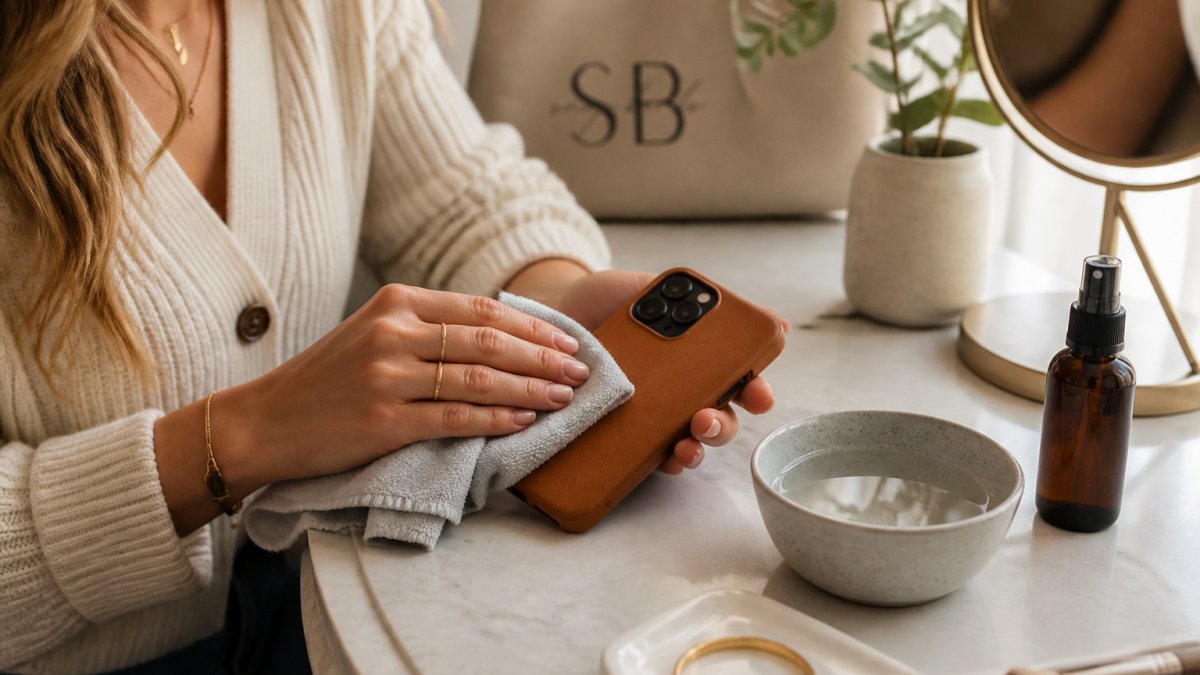
Watch out: alcohol wipes, hand sanitizer, and household cleaners will strip the finish and leave permanent marks. Keep them away from leather.
How Leather Ages: Patina, Scratches, and the Beauty of Wear
Not every mark is charming, though. Deep gouges, cracking along folds, and a surface that feels dry and papery are signals that the leather needs conditioning, or that it was low-grade to begin with. Learn to tell the difference and you will get years more from your accessories.
Choosing a Personalized Leather Case That Fits Your Daily Life
Our personalized iPhone case collection includes options such as the black personalized monogram leather iPhone case.
Frequently Asked Questions
Does engraving or embossing weaken personalized leather?
The Blue Personalized Monogram Leather iPhone Case is crafted from premium leather and lets you add your initials.
How long does genuine leather last with everyday use?
The Blue Personalized Monogram Leather iPhone Case is crafted from premium leather. The product listing does not specify a lifespan.
Is personalized leather more durable than faux leather?
The Blue Personalized Monogram Leather iPhone Case is crafted from premium leather.
How do you care for personalized leather accessories?
Wipe the surface with a soft, dry cloth to remove dust, then use a leather conditioner sparingly to keep the material supple. Avoid soaking the leather or using harsh chemicals, and let water spills air-dry away from direct heat. Store the item in a dust bag when not in use. For engraved or embossed areas, use a soft brush to lift dirt from the recessed lines without scratching the surrounding finish.
Does personalized leather scratch or fade easily?
The product listing describes the Blue Personalized Monogram Leather iPhone Case as crafted from premium leather and allows you to add your initials.
Daily wear tests leather, and it should. The question is whether you are carrying a piece built to handle it. At Snap Bands, we make premium phone cases and watch bands with durable construction, customizable colors and patterns, and comfortable all-day wear, so your accessories keep up from the office to your next adventure. Explore the collection and find a personalized piece that fits your everyday. Get started with Snap Bands and carry something that only gets better with time.


